A 30-day pop-up social network for festival season in the Coachella Valley.
Built in weeks. Run for 30 days. Gone on May 1. A SunshineFM experiment in temporary social infrastructure, AI-assisted building, and local startup possibility.
Two festivals. Three weekends. A social network built for a place and a moment — not for an addiction loop. Coachella gave us our peak. Stagecoach gave us our lessons. The shutdown gave us the story.
Festival goers this year now have a new network to connect with each other. KESQ News Channel 3 covered Mirage six days before Coachella Weekend 1, reporting on the pop-up good vibes network built with AI assistance in under a week — and exploring whether social software can be designed to break the addictive cycle instead of feeding it.
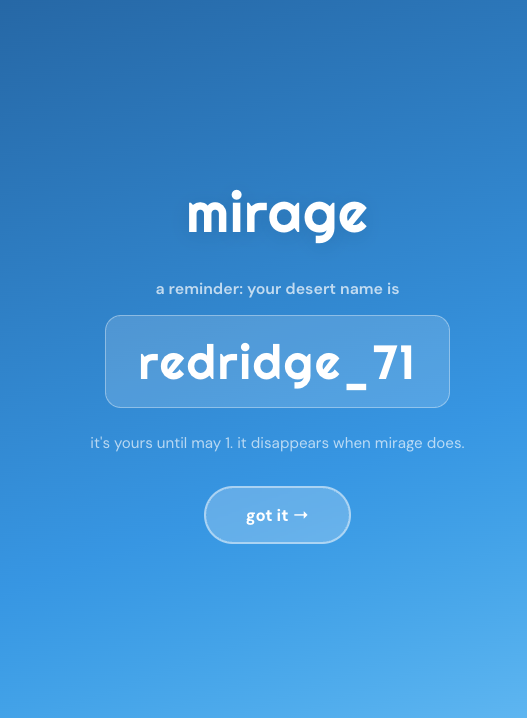
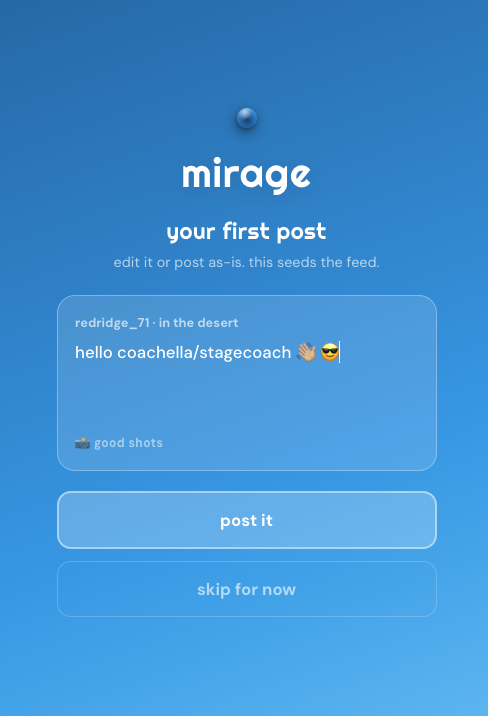
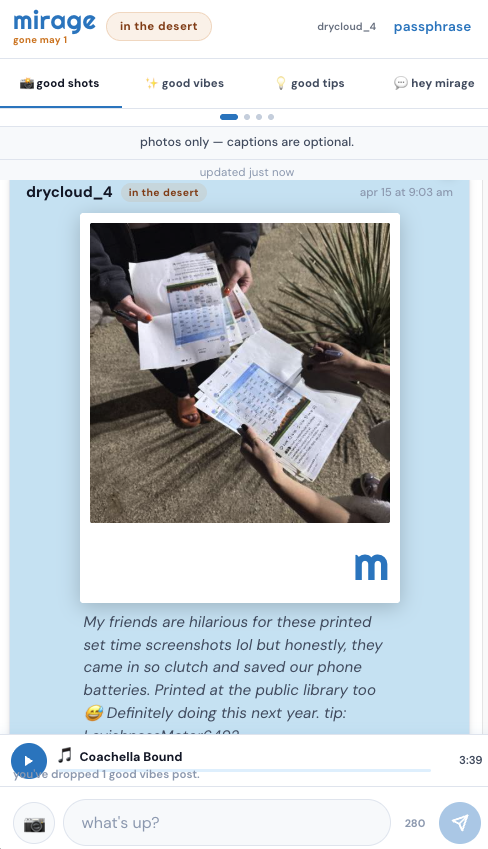
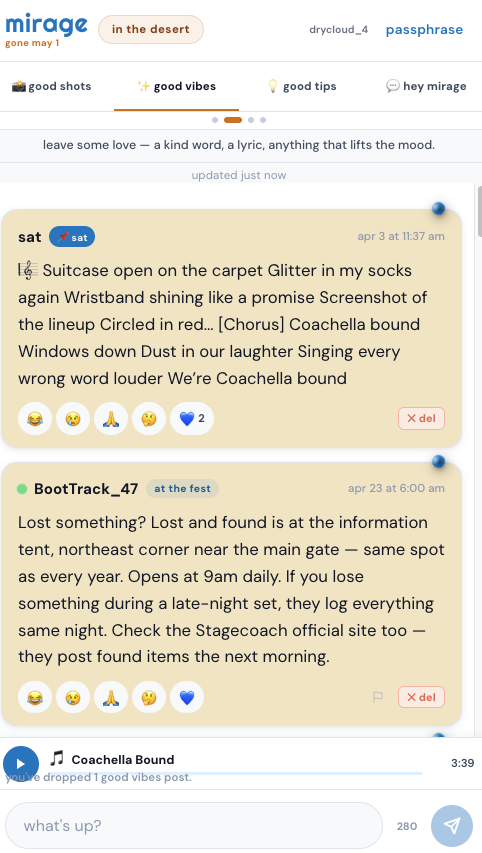
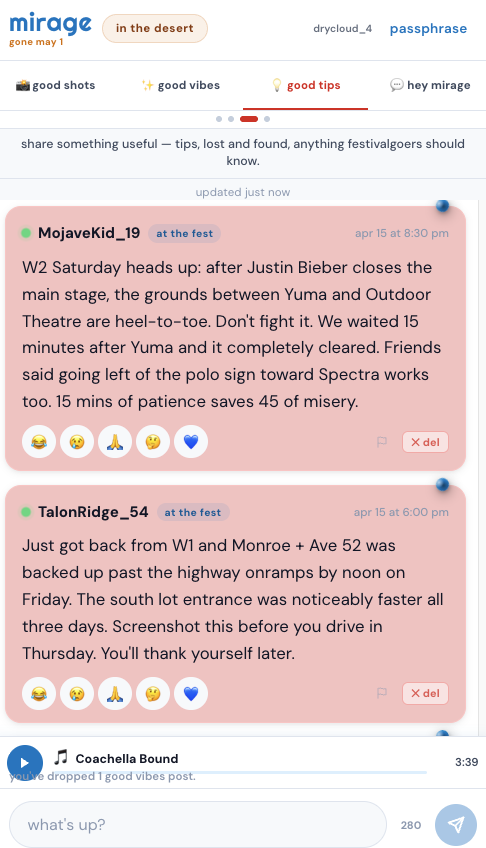
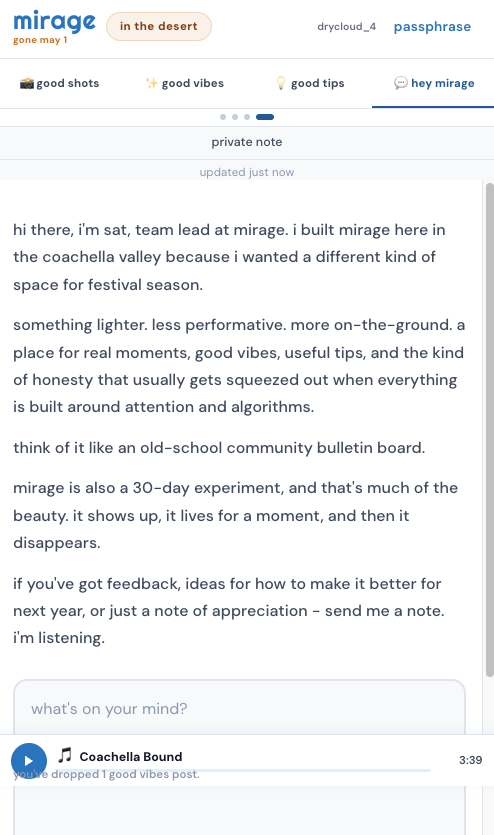
Read on KESQ →Captured before the May 1 shutdown. Mobile-first, blue desert sky palette, zero accounts required.
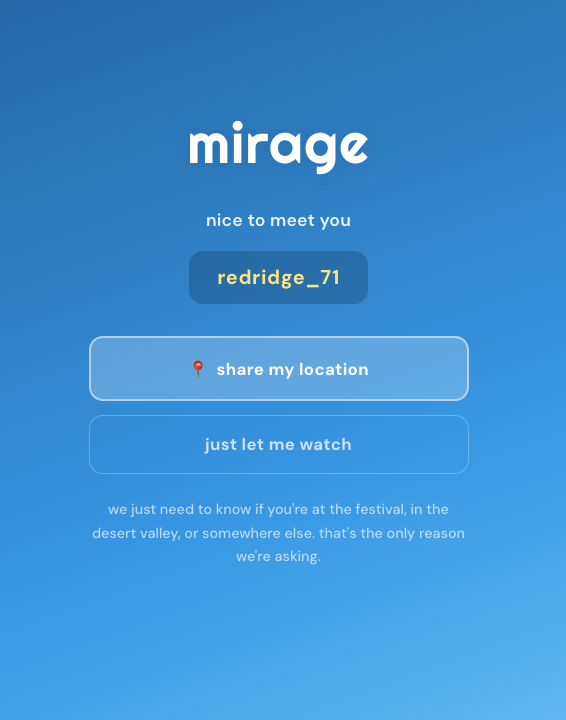
Tap any screenshot to enlarge.
Mirage started as a question: what would social software feel like if it was built for a moment instead of an addiction loop?
Then it became something bigger. The real experiment wasn't just about the product. It was about what's now possible here — in the Coachella Valley — with the tools available today.
This section exists because the "how" is the ecosystem thesis. Not the what.
Mirage was built with AI-assisted engineering, AI video creative, lightweight hosting, a serverless database, and a small paid media test. The total project investment was roughly $329 — the SunshineFM platform subscription (~$98 over ~2 months) plus ad spend (~$231 including the platform fee, across all 7 creatives), with about 50 executed tasks across engineering, ads, analytics, research, and content.
Zero employees. One person. 45 days.
That's not a flex — it's a data point. A local builder in the Coachella Valley, with AI tools and $329, can ship a product that gets real users. The question is no longer "can we afford to build it?" The question is: what are we building?
That honesty makes this credible. If it reads like "everything worked," nobody serious will believe it.
The original track and the AI-generated ad creative that drove Season 1.
Played on loop inside the app during festival weekends. Part mystery marketing hook, part festival soundtrack.
The full Season 1 ad slate — all 6 other creatives tested during Stagecoach, ranked by spend.
Digital-only wasn't enough. The next version needs QR codes at venue entrances, on-site humans who can answer "what is this?", and partner locations as distribution points.
"Tips, music, insider knowledge" performed better than "ephemeral social network." The product's mechanism was novel. The value proposition had to be concrete.
The tools made it cheap and fast. Human judgment still mattered for positioning, local knowledge, product restraint, and knowing when something wasn't working.
That's the ecosystem thesis. Mirage suggested — not proved — that temporary social infrastructure can work here. But only when paired with physical activation, real-world distribution, and operational reliability.
How it ended. Designed from the first day. A shutdown that felt like a period, not an ellipsis.